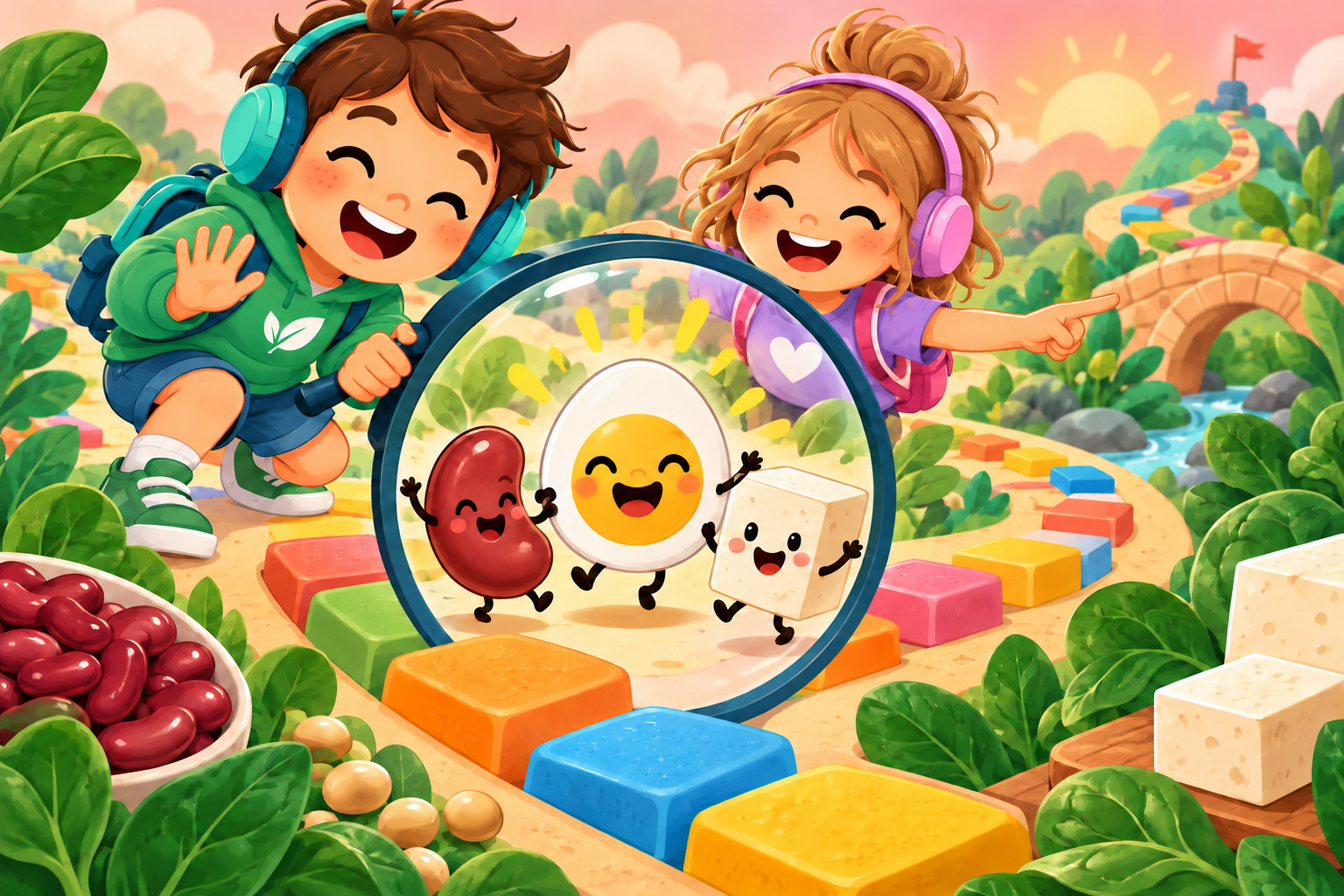
Where does your protein go after you eat it? Follow a bite of food through digestion in this health episode for kids ages 4–10. Tara uses a necklace-and-beads picture to explain amino acids: the small building blocks your body gets when it breaks down protein.
Learn how your small intestine takes in those building blocks, how your blood carries them onward, and how your body uses them for growth and repair. Then discover plant and animal protein foods, including beans, lentils, tofu, eggs, fish and chicken. The episode connects digestion and nutrition through our functional medicine lens, with a four-question quiz and a free protein activity pack and parent guide.
Inside this adventure
From a bite of food to tiny building blocks
Picture protein as a string of beads, then learn the name for its smaller pieces: amino acids.
The journey through digestion
Follow food to the stomach and small intestine, where useful small pieces can pass into your blood.
Protein foods for your family
Discover plant and animal food examples and find a protein food in a meal you already enjoy.
Your four-question recap
Check what you remember about amino acids, absorption, food sources and the jobs protein helps your body do.
Go at your own pace. You can answer out loud, think quietly, skip a question, or explore with a parent. Every kind of curious is welcome.
LET'S WONDER TOGETHER
What did you discover?
Have a guess. This is about exploring, not getting a perfect score.
A STORY TO EXPLORE TOGETHER
The episode transcript
Where does your protein go?
Hi, I'm Tara. I'm glad you're here. Welcome to Healthy Kids Daily.
I've been thinking about a very strange delivery. Imagine eating a bite of a scrambled egg. Or some beans. That food starts on your plate. But later, your body can use little parts of it to help build your muscles and skin.
Hang on. How does a bean help build a person? You don't have little beans rolling down your arms! And an egg doesn't squeeze into your muscles, either.
There's a journey in between. Today, we're following protein from your food to the places your body uses it.
First, think about a meal you enjoy. It could have eggs, beans, lentils, tofu, fish, or chicken. Which food comes to mind? Say it, point to an imaginary plate, or just keep it in your head.
Keep that meal in mind. We'll come back to it.
Protein is one of the nutrients in food. A nutrient is something your body needs to do its jobs. Foods usually have a mixture of nutrients. A bean doesn't have only protein in it. Neither does an egg.
Here's the bit I find interesting. A protein is made from smaller pieces joined together. Those pieces are called amino acids.
Picture a necklace made of beads. For our picture, the whole necklace is a protein, and the beads are amino acids. Your body can take a chain apart and use its pieces to make something it needs. There aren't real necklaces inside your food. It's a way to picture something much too small to see.
So, where does that taking-apart job begin? The journey of your food begins in your mouth. Your teeth break the food into smaller pieces, and saliva, the watery stuff in your mouth, mixes with it. Chewing gets food ready for the next part of digestion. Digestion means breaking food down so your body can use it.
After you swallow, the food travels down a tube to your stomach. Your stomach mixes it with digestive juices. Those juices include acid and helpers called enzymes.
An enzyme helps a chemical job happen in your body. Some digestive enzymes help take protein chains apart. Think of separating the beads in our necklace picture. Chewing made the bite smaller. These helpers work on the tiny protein chains inside it. That's a different kind of smaller!
The job continues in your small intestine. It's a long, soft tube tucked into your belly. More digestive enzymes help break protein down into pieces your body can take in, including amino acids.
Then comes the delivery. Amino acids can pass through the lining of your small intestine into your blood. Your blood carries them on through your body.
I like that teamwork. Your mouth, stomach, small intestine, and blood are doing different jobs in one connected journey. Your stomach doesn't have to do everything by itself.
Let's stop at those building blocks for a moment. Amino acids. That's two words: amino, acids.
They're the small pieces your body uses to make proteins. If you want, try saying the name with me. Amino acids.
You can keep the words, or just keep the picture of little building blocks. Both help us follow the journey.
Now, where do those pieces go? Your body uses amino acids to make its own proteins. Some become part of muscles. Some help make skin and other tissues. Tissue means a group of cells working together, like the cells in your skin.
Proteins aren't only building material, though. Remember enzymes, those helpers in digestion? Many enzymes are proteins, too. Your body makes proteins that do all kinds of jobs.
And I've got a spider connection for you. The silk in a spider's web is made from proteins, too! A spider makes silk proteins, while your body makes the proteins it needs. Proteins can do very different jobs. I wouldn't have guessed that a web and your muscles had protein in common.
And here's a connection to your brain. Some amino acids are ingredients your body uses to make chemical messages. Those messages help brain cells communicate. Other nutrients help with that work, including vitamin B6. So protein is part of a whole team. One food doesn't suddenly turn on focus or make a feeling disappear.
Your body can make some amino acids for itself. But there are others it needs to get from food. Those are called essential amino acids. Essential means you need them. Getting different protein foods helps bring those needed pieces to the team.
That doesn't mean more and more protein is always better. Your body also needs other nutrients, enough food, movement, and rest. We're learning about one important teammate today.
So what could you actually do with this at mealtime?
Here's my first food-detective tip. With a grownup, look for a protein food in a familiar meal. Maybe lentils in soup. Egg with breakfast. Tofu with rice. Fish, chicken, or beans with dinner. You don't have to choose the same one as somebody else.
Second, let different foods share the job over time. Beans, lentils, and tofu come from plants. Eggs, fish, and chicken come from animals. Different meals bring different combinations of nutrients. Your grownup can help find choices that fit your family and foods your body can have.
And third, give mealtime a little space. Sit comfortably and take time to chew the food your grownup has prepared for you. Chewing starts that journey by breaking the food into manageable pieces. There's no special chewing number to count.
You don't need to eat anything right now. Just imagine your next meal. Which protein food could you look for? Maybe the one you thought of at the start. Pick one in your mind.
Keep your food in the picture. It starts on a plate, and digestion helps turn its protein into little pieces your body can use. There's our answer to the bean mystery. A whole bean doesn't become a muscle. Parts of the food become building material after digestion.
Let's see what you remember. You can answer out loud, think quietly, or skip a question. We've got four.
Question one. When your body breaks protein down, what little building blocks does it get? A: amino acids. Or B: tiny whole eggs.
A: amino acids. The protein chain is taken apart into smaller pieces. Whole eggs don't travel around your arms!
Question two. Where can amino acids pass into your blood? A: through your hair. Or B: through the lining of your small intestine.
B: through the lining of your small intestine. After digestion breaks food down, your body takes useful pieces in. Your blood helps carry them onward.
Question three. True or false: protein foods can come from plants as well as animals.
True. Beans, lentils, and tofu are some plant examples. Eggs, fish, and chicken are some animal examples. There are lots of ways for a family to find protein foods.
Last question. What does protein help your body do? A: grow, repair tissues, and make useful proteins. Or B: grow a new muscle instantly after one bite.
A: grow, repair tissues, and make useful proteins. It takes teamwork over time. One bite isn't an instant muscle trick.
So here's our journey in three steps. Digestion takes protein apart. Your small intestine takes in the little pieces. Your body uses those pieces to make proteins it needs.
And here's the useful bit for later. Find a protein food in a meal you already enjoy. Remember that different foods bring different helpers, and protein is one part of feeding your whole body.
I started with a bean and a very odd delivery question. Now we've followed the route. From food, to small pieces, to useful building material. Your body is pretty busy, even when it doesn't look busy from the outside.
Grownups, find our free activities and short parent protein guide, with food ideas and written references, at healthykidsdaily.com. That's Healthy Kids Daily dot com.
Thanks for figuring this out with me. I'll see you for another question soon. Healthier kids, happier tomorrows. A podcast from My Health Optimized.
FOR PARENTS
A little more to explore.
Our approach connects everyday habits with the ways our brains and bodies work. These references support the educational concepts in this episode.
From the My Health Optimized functional medicine library: The Pegan Diet; The UltraMind Solution; Finally Focused: The Breakthrough Natural Treatment Plan for ADHD (Greenblatt).
Use the parent guide for conversation starters and ideas you can adapt to your family. Individual questions about your child's health belong with a qualified professional who knows them.
Not medical advice. Healthy Kids Daily is a wellness and education resource from My Health Optimized. Its content does not diagnose, treat, or prescribe. My Health Optimized’s coaches are not a substitute for a licensed clinician. Always consult a qualified healthcare professional about your or your child’s health.